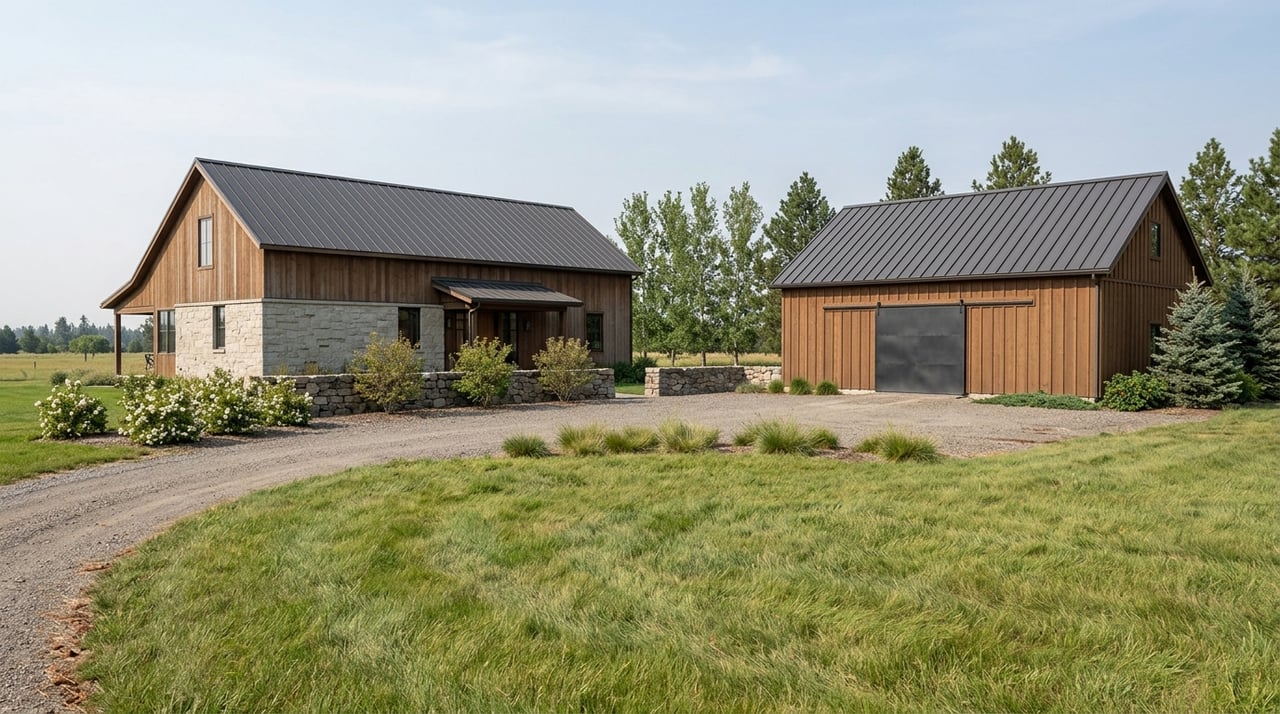
Drive the back roads around Daniel this August and you can see something a normal year hides. One pasture is still deep green under sprinkler heads that haven't stopped turning. The field across the fence line has gone straw colored, cut short weeks ago, waiting on water that isn't coming this month. Both properties sit on the same soil, in the same valley, drawing from the same river system. The difference isn't the rancher. It's a priority date filed with the state decades before either of them owned an acre of it.
If you're evaluating a horse property or working parcel in Heber Valley this year, that difference should matter to you more than the price per acre. A green field in a wet year tells you almost nothing about whether the water on it is actually yours to keep. This drought is the rare year that shows you the truth before you close, if you know where to look.
This Is the Year the Priority System Actually Bites
Utah entered 2026 already behind. The Natural Resources Conservation Service called it the worst winter for snowpack the state had seen going back to at least 1930, and on May 21, Governor Spencer Cox issued a statewide emergency drought declaration. Wasatch County was among the counties already sitting in extreme drought conditions at that point.
Heber City responded on June 16, when the City Council voted to enter Phase II of its four-phase Water Shortage Plan, a voluntary conservation push meant to stretch the pressurized irrigation season, which normally runs from April 15 to October 15, all the way to September 15 this year. Residents were asked to limit lawn watering to three days a week in June through August and two days a week in the shoulder months.
The number that should get a buyer's attention came out of a mid-June council meeting, when Central Utah Water Conservancy District project manager Chris York told the council he'd learned that day that "all the high water in the Provo River is gone." That meant only about 80 percent of the river's first-class water rights, the ones that hold priority when supply runs short, could actually be satisfied. York pointed out that during a comparable decline back in 2021, that figure fell from 80 percent to 60 percent in just four days.
That volatility is the whole point. Priority isn't paperwork trivia that sits quietly in a file. In a year like this one, it's the live mechanism deciding, week to week, whose sprinklers keep running and whose don't.
A Right and a Share Are Not the Same Purchase
Utah treats all water, on the surface or underground, as public property. What the state grants individuals is permission to divert and use it, and that permission is called a water right. A water right behaves like real estate: it carries a priority date under the doctrine of first in time, first in right, and it's regulated by the State Engineer through the Division of Water Rights.
Most agricultural parcels in Heber Valley don't hold a water right directly, though. They hold shares in one of the valley's irrigation companies, such as Wasatch Irrigation Company, Timpanogos Irrigation Company, or Daniel Irrigation Company, and it's the company that holds the underlying right. That distinction changes everything about how the property closes.
| Water Right | Water Share | |
|---|---|---|
| Legal treatment | Real property | Personal property |
| Governed by | State Engineer / Division of Water Rights | The individual irrigation company |
| Transfers with the deed? | Tied to the land, but must still be confirmed | No, requires a new stock certificate from the company |
| Ongoing obligation | None beyond the right itself | Annual assessments for canal and headgate maintenance |
| Priority in a shortage | Has its own priority date | Inherits the priority of the company's underlying right |
A share doesn't move automatically when you sign at closing. Someone has to contact the company's secretary and get a new certificate issued in the buyer's name, and until that happens, the seller's name is still the one of record.
What the Purchase Contract Actually Promises
Utah's standard Real Estate Purchase Contract, the form nearly every transaction in the state uses, has a specific line item for this. Section 1.4 addresses water rights and water shares as part of what's included with the property, but it only works if the shares or right are actually named there, by number or count, rather than left as an assumption.
The Seller's Property Condition Disclosure form fills in some of the gap. It asks whether a well is present on the property, whether there have been past problems with it, and whether the water right tied to that well is represented by a contract with a special improvement or conservancy district, in which case the seller lists the contract number, or by a State Engineer index number if it isn't. What the form doesn't do is verify any of it for you. Utah is a buyer beware state. Sellers are required to disclose known defects that a buyer couldn't find through a reasonable inspection, but the burden of confirming a water share is transferable, current on its assessments, and actually usable on this parcel sits with the buyer's own due diligence.
A revised version of the REPC has already cleared the Utah Real Estate Commission and is headed toward the Attorney General for approval, with a target rollout of January 1, 2027. That means this year's contracts, and this year's due diligence period, still run on the current form.
What to Confirm Before Your Due Diligence Deadline Closes
Before you sign off on the property, a few calls are worth making that a standard home inspection won't cover:
- Call the irrigation company's secretary directly and confirm the seller currently holds the shares listed in the contract and that all assessments are paid in full.
- Ask about "the turn," meaning how and when water actually reaches this specific parcel, whether by open ditch, buried pipe, or pump, and what maintenance responsibility comes with it.
- Search the property by location or water right number in the Division of Water Rights' public database to confirm the "place of use" on file matches the parcel you're buying, not a different one under the same historic ownership.
- Ask what the company charges to issue a new certificate in your name and whether that fee is customarily paid at closing.
- If the seller has owned the land for years but the water right still shows a previous owner of record, ask whether a Report of Water Right Conveyance has been filed to bring the paperwork current.
- Ask specifically about this season. Did the property receive its full delivery under Phase II, or was it already curtailed? A seller's answer, or a look at the pasture itself, tells you more about priority quality than the deed ever will.
What Changes If Heber City Reaches Phase III
No phase of Heber City's shortage plan touches culinary water, the treated water that comes out of the tap. The city pulls that from wells within its own boundaries, which tend to hold up better through a dry year than snowmelt-fed secondary supply does. Phase III, if it's triggered, would make the current voluntary guidelines around lawn watering, hard surface washing, and pool levels mandatory, aiming for a citywide reduction of 15 percent or more.
Agricultural cutbacks work on a separate track entirely. Any reduction to irrigation shares would come from the individual companies and the Central Utah Water Conservancy District based on real-time river flow, not from a city council vote. The conservation infrastructure behind those companies, including the Timpanogos Diversion below Jordanelle Reservoir and the pressurized pipelines that have replaced flood irrigation across roughly 3,675 acres of the valley, was built in part to stretch exactly this kind of dry year further and to keep supplemental flow moving into streams like Rock Ditch, Spring Creek, Lower Lake Creek, London Ditch, and Creamery Ditch. It helps. It doesn't eliminate the underlying priority math a buyer still needs to check.
Frequently Asked Questions
Does a green, well-irrigated pasture mean the water rights are senior and dependable? Not on its own. A property can look fine through most of a normal season regardless of where its priority date falls. This year is unusual precisely because the shortage is deep enough to expose that difference visually. Treat what you see this August as one data point, not a substitute for pulling the actual water right records.
If the property has its own well, does that solve the water question? It solves a different question. A private well typically serves culinary use and is disclosed separately on the Seller's Property Condition Disclosure form, with its own questions about water quality and pump problems. Irrigation for pasture, an arena, or landscaping in Heber Valley usually comes from a separate secondary or irrigation-company source, and that has to be verified independently of the well.
What happens to my purchase if the city moves to Phase III or IV before I close? Nothing about your culinary water changes, since no phase restricts it. What's worth checking near closing is whether the specific irrigation company serving the parcel has announced its own cutbacks for the season, since those decisions sit with the company and CUWCD rather than with the city council.
Water rights are one of the more overlooked pieces of a Heber Valley ranch purchase, and this is the year they're hardest to ignore. Peterson Calder, operating as Experience Park City, works these large-acreage and equestrian transactions regularly and can help you get the right questions in front of the right people before your due diligence period runs out. Search Current Listings to see what's currently available across Heber Valley's ranch and acreage market.